I thought this article might be helpful to homeowners wading through their tax returns.
http://homes.yahoo.com/news/own-home-check-8-tax-breaks-181101848.html


I thought this article might be helpful to homeowners wading through their tax returns.
http://homes.yahoo.com/news/own-home-check-8-tax-breaks-181101848.html
I hope you never have to use our most recently added service! If you ever experience the unfortunate event of water, fire, smoke, or sewage damage in your home, we can help. I’m excited to announce we now have a 24 hour response team that dries out, cleans up, and can make any necessary repairs to your home due to these type damages. They also offer mold remediation & asbestos testing.
The Edmonds Business Expo is June 1 from 10:00 am-4:00 pm at the Edmonds Conference Center at 201 4th Ave N, Edmonds. Admission is free of charge. Stop by while you are enjoying the Edmonds Saturday Market and say hello. We hope to see you there!
Winter Special – 5% off, up to $100! Do you have a special project or home repair you have been putting off? Take advantage of our winter special and let us help you get it done. Give me a call at 425-775-9085 or www.contractorhotline.net. Rebate check mailed upon completion of work and payment for services have been satisfied. Offer does not apply to closed or existing projects currently underway. Offer expires Mar 15, 2013.
Got rot? Those of us who live in Western Washington know it’s wet, really wet! Left unattended, small leaks can become big problems. Failed flashing & caulking, warped/buckled roofing & siding, and bubbling paint are some of the signs moisture could be getting into the wrong places. Inspect your home’s exterior regularly and if you suspect a leak, get it checked out.
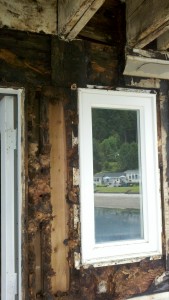
Rot around bath windows
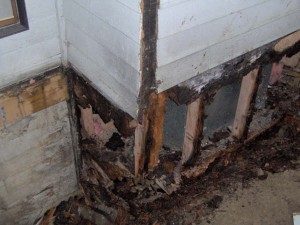
Failed deck flashing where attached to house
Dreaming of warmer days to play in the garden? Start saving wine bottles now to make colorful and useful borders for your garden beds or walkways. Plan now to make your wine bottle garden border this spring.
Are you or your landlord in compliance with Washington’s new carbon monoxide detector law, effective Jan 1, 2013? Carbon monoxide detectors are inexpensive, easy to install, and most importantly, save lives. The Seattle Fire Department has prepared an informative memo regarding the new law’s specific requirements. Even if you are currently exempt from this law, there is no good reason not to have a detector in your home. Please add it to your list of resolutions and make your home a safer place for you and your family (including your four-legged friends).
Home energy audits help you understand how much energy your home uses and identify ways to improve its efficiency. There are many things you can do on your own such as caulk and weather strip around doors and windows or wrap exposed water pipes. But many homes are so inefficient that even after completing the more obvious improvements, there are still many ways to further reduce your home’s energy consumption and increase comfort.
A professional audit can cost upwards of $400 or more but when used wisely can pay for itself in a short amount of time. If this is out of your budget, there are do-it-yourself alternatives. For starters, there are easy online surveys such as Energy Star’s Home Energy Yardstick. The survey compares your home’s efficiency to similar homes in your area. Another, more comprehensive self-study is the Home Energy Saver. Snohomish County PUD also offers a free online energy audit called the Home EnergyAdvisor.
While an online audit can be a good starting point, it is no substitute for a home inspection by a professional energy auditor. A Home Energy Audit is an investment to help you determine the best steps to increase your homes efficiency.
The many benefits to a Home Energy Audit and related improvements include:
Many home improvements such as adding insulation or replacing the furnace are not inexpensive. Having an audit conducted before making these improvements will help prioritize the best approach for long term value. It doesn’t do much good to install a new heating system if the air leaks have not been addressed. Planning a remodel? Having an audit completed before starting a remodel will help you plan and incorporate energy saving upgrades into your project.The following are questions to consider when determining if your home is operating as efficiently as it could.
A thorough inspection will determine what components are negatively affecting the comfort and efficiency of your home. Based on the inspection results, you should have a good understanding of recommended repairs and improvements, along with an idea of estimated costs and potential annual savings in energy bills.
A professional auditor uses a variety of techniques and equipment to determine the energy efficiency of your home. A thorough audit will include:
The following video provided by the Department of Energy explains each of these steps in detail.
| Energy 101: Home Energy Assessment |
Home Energy Audits alone won’t save energy. You need to implement the recommended improvements. The results of the audit will help prioritize repairs and put a short or long term plan in place, depending on the extent of improvements needed and your budget.
A Home Energy Auditor should be certified through either BPI (Building Performance Institute) or RESNET (Residential Energy Services Network). Both BPI and RESNET have set standards for home energy professionals and are recognized by the DOE (Department of Energy) and EPA (Environmental Protection Agency). View a list of certified BPI accredited contractors near you.
Currently Seattle City Light customers can obtain a Home Energy Audit for $95. Rebate programs are available and in some cases, free weatherization services for those who meet income qualifications. For more information visit the Energy Conservation page of their website or call an Energy Advisor at 206-684-3800.
Puget Sound Energy (PSE) offers their natural gas customers a free HomePrint Assessment of their home’s energy use. The review is determined by a visual walk-through but does not include any diagnostic testing such as blower tests and infrared camera scans. You will receive a summary that includes energy saving recommendations and free compact fluorescent light bulbs. For more details, contact a PSE Energy Advisor at 1-800-562-5482.
Snohomish County PUD customers whose homes are electrically heated may qualify for incentive payments toward energy-saving home improvements. The weatherization program includes eligible upgrades on windows, heat pumps, duct sealing & insulation, and electronic thermostats. Contact the Energy Hotline with questions at 425-783-1700.
Beware – Energy Saving Scams! Snohomish County PUD warns of a postcard scam targeting home and business owners. If you received a notice in the mail, someone visited your home or business, or you received a phone call claiming they can help slash your utility bills, please beware. Visit Snohomish County PUD’s website for more details to avoid becoming a victim of an energy saving scam.
No matter how large or small your next project, there are simple ways to lower costs and increase value. You get what you pay for – can be especially true when hiring a contractor. While it might be tempting to hire the cheapest contractor you can find, that can and often does backfire. There are many other ways to save money while maintaining quality. Following are some useful tips that can help cut costs and add value to your home without sacrificing reliability and quality of workmanship.
Shop carefully for materials
You can save a lot of money shopping sales and comparing materials at different suppliers. For example, if you are installing hardwood floors, you may be able to save several thousand dollars on materials by choosing flooring that runs $10/square foot vs. $14 that is just as good. Habitat for Humanity’s Home Improvement Outlet Stores in Seattle and Everett (newly opened!) can be valuable resources. They are open to the public and offer deep discounts on a wide variety of home furnishings including appliances, doors, windows, flooring, countertops, plumbing fixtures, and much more.
Additional resources are Second Use and The RE Store in Seattle. These stores not only save you money, they help prevent perfectly good building materials from ending up in a landfill.
Consider doing projects in the off season
Most contractors start getting busy in the spring and slow down late fall and winter. If you plan your project when their schedules are open you won’t be competing with other homeowners who may have bigger budgets or bigger jobs. A perfect example is of a time when one of our customers was planning a kitchen remodel. They chose to have it done in November, during Thanksgiving of all times! The contractor was thrilled to have work at that time of year, negotiated a good price for them, and was able to give them his undivided attention until it was completed well before Christmas.
Consider doing your project in stages
If you have found a reliable contractor but his bid is too high and there is no room for negotiation, consider doing the project in stages. A good contractor will recognize that gaining a customer for a smaller job with prospects for future work is worthwhile.
Talk to References
Before hiring any contractor, ask to speak with other homeowners who hired the contractor for a similar project. Ask them about their experience and where they felt they could have saved a few dollars.
Consider doing prep work yourself where you can
For example, if you plan to have the exterior of your house painted, you can save money by clearing the area around the house yourself and power washing just prior to when painting is scheduled to begin.
Reconsider your plans
Review the details of your project with your contractor and ask if there are any design elements in your home that can stay and be incorporated into the job rather than replaced. For example, perhaps you can save money (and not compromise too much on design) if you paint and reuse doors rather than purchase new ones.
Avoid Water Damage From Failed Hoses & Fittings
Short of fire, nothing causes more damage to the inside of your home than leaking water from failing pipes, hoses, plumbing fixtures, and appliances. A failed hose connection on an unattended washing machine can cause devastating damage in a short amount of time.
Did you know most hoses and fittings that come with new washing machines are low quality, usually lasting no more than four or five years? A high-quality pair of washing machine hoses can be purchased for about $40 and is a low-cost investment compared to the thousands of dollars of damage that can be incurred by a failed hose fitting.
Pull The Plug
Many household appliances draw power even when they are not on. Power surges can damage them and they use unnecessary electricity in your absence. Defective appliances and wiring can also pose a fire hazard.
Home Security
Take some simple steps to make your home look lived in while you are away on vacation. These preventative measures will go far in deterring potential intruders.
Do Not Alert The World You Are On Vacation
It has become increasingly popular to broadcast what we are doing, where we are, and who we are with on social networking sites like Facebook and Twitter. Think about who has access to this information. Most likely there are hundreds of strangers with access to your postings who you would not likely choose to announce you are leaving your home unattended for two weeks.
Last Minute Items
Have A Fabulous and Carefree Vacation!